The January Term
Three weeks inside a Chinese boarding school while it is actually running — 3,000 students in class, Mandarin every morning, a one-to-one Chinese buddy all day, and the last day of the Chinese autumn term. January is the only month this window exists: your school is on holiday, theirs is not.
Bring a friend — you both save USD 150 · from USD 2,650 each · 20 places only (10 girls / 10 boys) · Minimum 8 to run · 3–23 January 2027
Why families choose this camp
It is a low-risk way to find out whether studying in China is right for your child — before committing to a full year.
Two or three weeks, three themes
3 – 23 January 2027 · hosted at Star Trusted School (Guangzhou Xingzhi School), Guangzhou · the final three weeks of the Chinese autumn term
Survival Mandarin & Campus Life
- Pinyin, tones, greetings, self-introduction
- Numbers, time, money — ordering food, asking directions
- Join a real class alongside current students
- Club try-outs: calligraphy, martial arts, basketball, choir
Culture & Expression
- Cantonese culture: dim sum etiquette, local greetings
- Laba Festival on 15 Jan — congee, pickled garlic, first red decorations
- Workshops: paper cutting, tea ceremony, Chinese painting, cooking
- Interview current international students — in Mandarin
Project & Showcase
- Team project: "My Guangzhou / My School / My Family"
- Final project build: display board, short video or slides
- HSK-style assessment with individual feedback
- Graduation on the last day of the Chinese autumn term
Key dates
A typical day on camp
Structured mornings, a coached sport every afternoon, social evenings — supervised throughout
| Time | Activity |
|---|---|
| 07:30 – 08:30 | Wake up · breakfast in the school canteen |
| 09:00 – 10:30 | Mandarin immersion session 1 — vocabulary & structure |
| 10:45 – 12:00 | Mandarin immersion session 2 — situational speaking |
| 12:00 – 13:30 | Lunch · rest |
| 13:30 – 15:00 | Culture workshop / join a class with current students |
| 15:00 – 16:30 | Clubs & sports — calligraphy, martial arts, basketball, choir, art |
| 16:30 – 17:30 | Study hall + one-to-one tutoring (twice weekly) |
| 17:30 – 18:30 | Dinner · free time |
| 19:00 – 20:30 | Evening programme — Mandarin corner, film, games, diary writing, rehearsal |
| 21:30 | Lights out |
Weekends are exploration days: Guangzhou city discovery (Chen Clan Ancestral Hall, Shamian Island, morning tea), a full day at the Guangdong Science Centre — the world's largest science museum, with hands-on halls on high-speed rail, new-energy vehicles, drones and space — Foshan for Wing Chun, lion dance and Shiwan pottery, the Guangdong Museum with a Pearl River night cruise, and University Town.
Four sports, taught as courses
Timetabled, coached and assessed like any other subject — five afternoons a week, 15 coached sessions across three weeks, all equipment included.
Swimming
Twenty-five-metre heated indoor pool. Stroke correction in ability lanes, then water safety and a 200-metre continuous swim test. Non-swimmers are taught separately.
Tennis
Four all-weather courts. Forehand, backhand, serve, then points — ending in a mixed-doubles ladder against the school's own team on the last Saturday.
Climbing
Twelve-metre indoor wall with top-rope and bouldering. Harness, knots, belay calls — by the second session most students climb routes they would not have looked at in week one.
Equestrian
The campus has its own stables and ménage. Grooming, leading, mounting and rising trot on a lunge line; competent riders go straight onto the track.
| Sport block 15:00–16:30 | Mon | Tue | Wed | Thu | Fri |
|---|---|---|---|---|---|
| Week one | Swimming | Tennis | Climbing | Swimming | Riding |
| Week two | Swimming | Tennis | Tennis | Swimming | Riding |
| Week three | Swimming | Tennis | Climbing | Swimming | Riding |
Swimming, tennis and climbing take place on campus during the normal afternoon sport block. Riding runs as an extended block and replaces study that day. Students with an injury or a medical restriction are given a modified programme — please tell us at application so we can plan it rather than discover it. The 2-week cohort takes 10 of these sessions, weighted the same way. Also on campus: an ice rink.
The campus you will live on
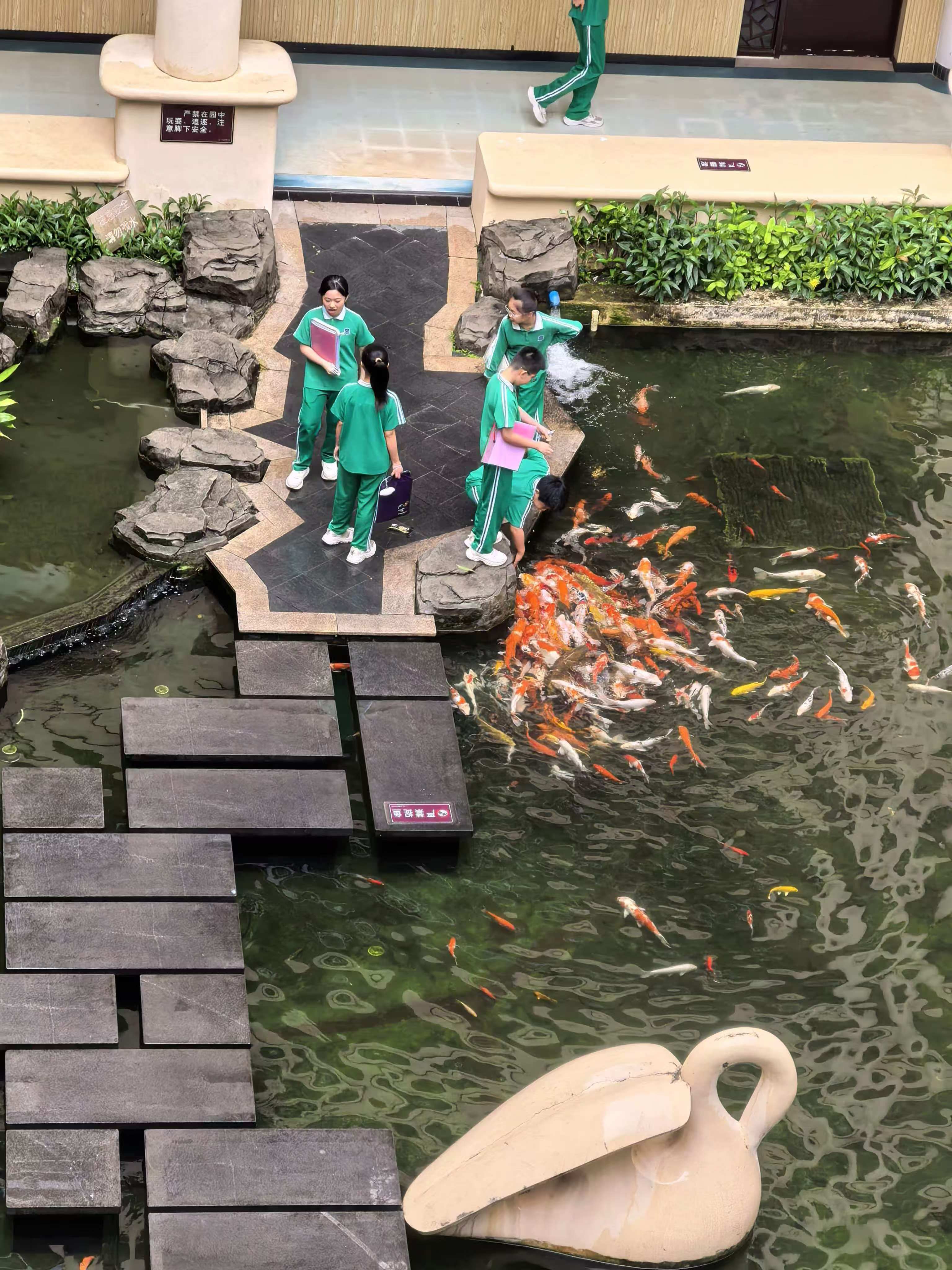
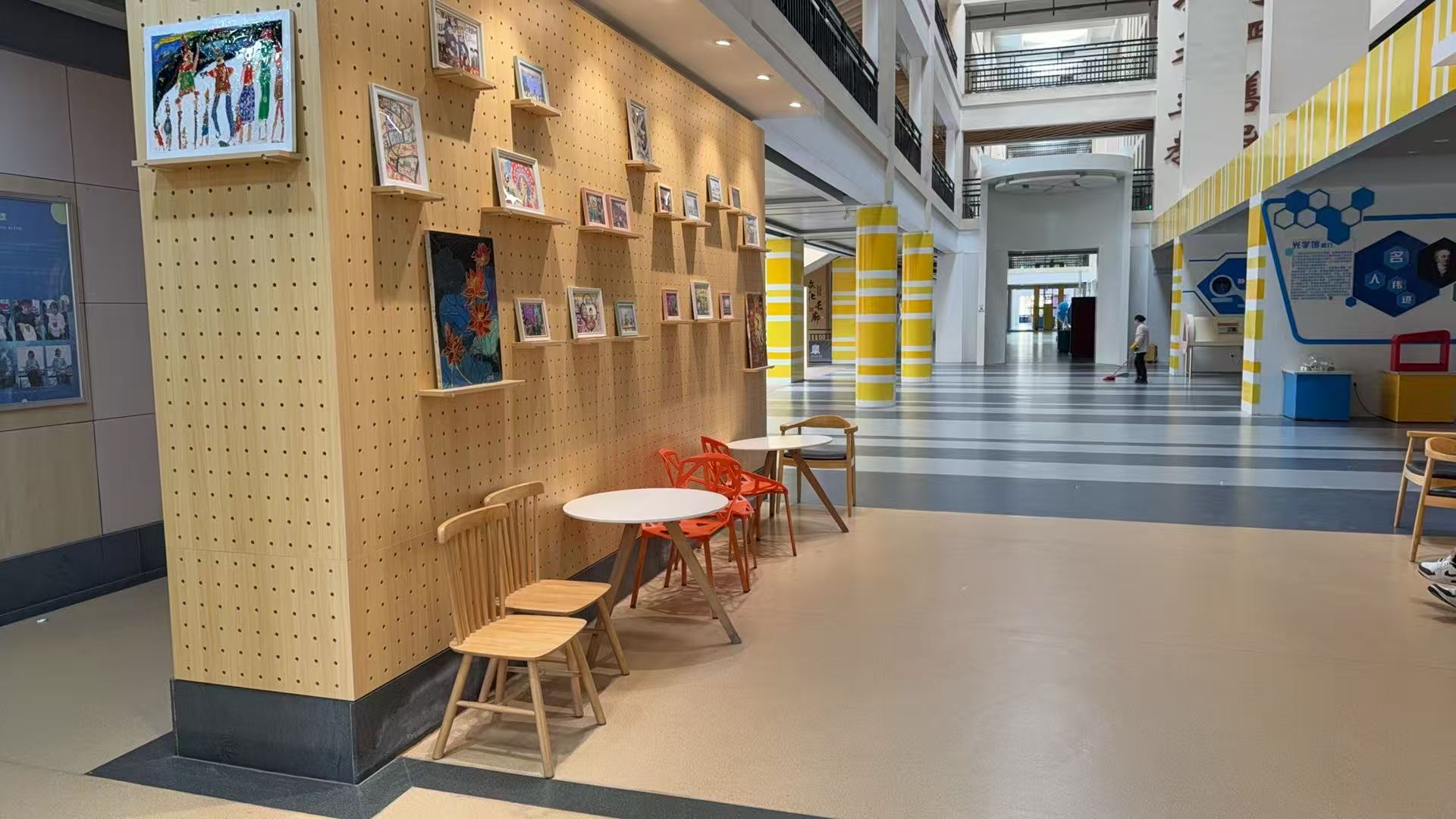
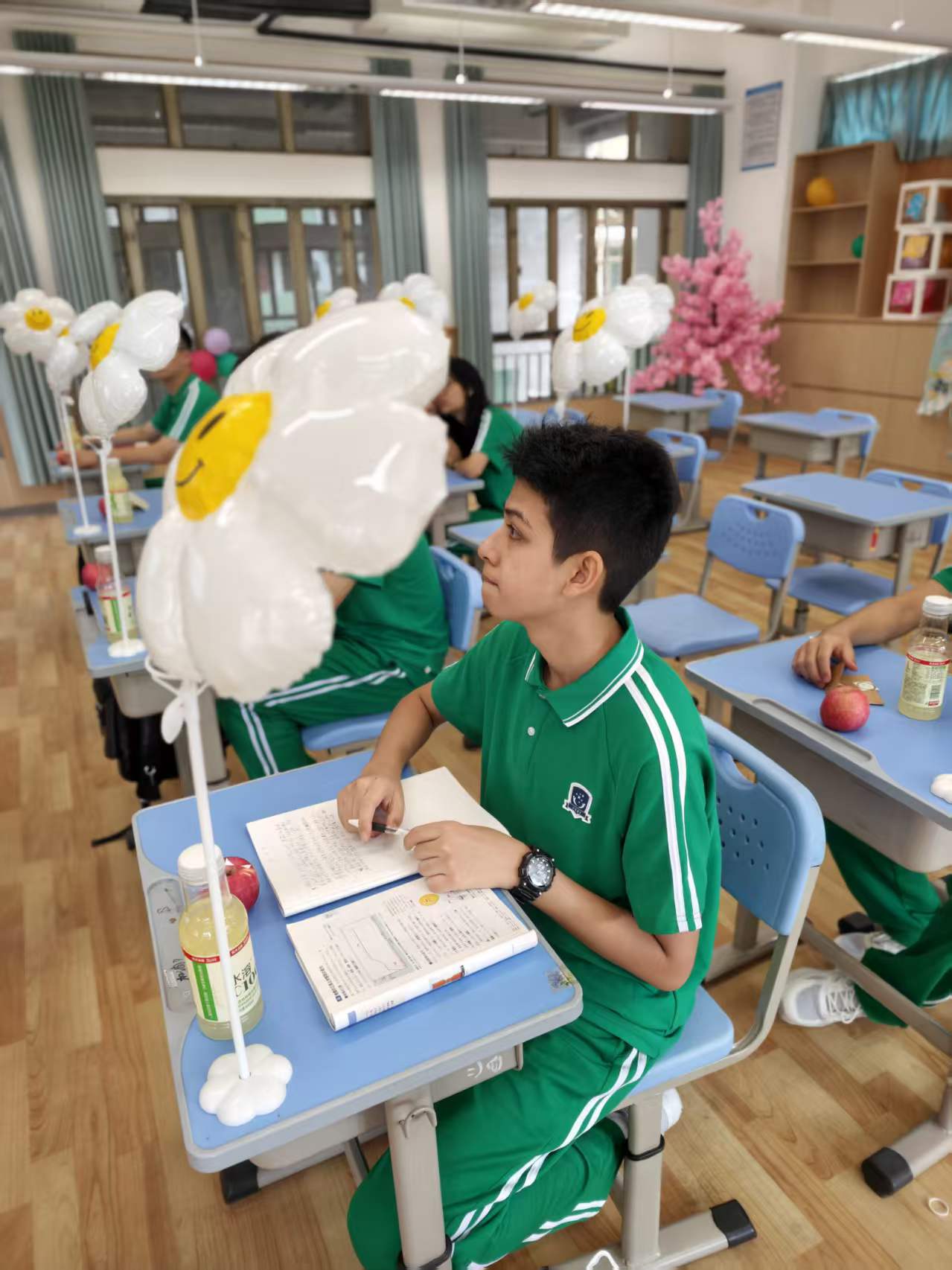
Xingzhi School, Guangzhou — a working boarding campus of 3,000 students, photographed on a normal school day.

Every student gets a Chinese buddy
This is what makes the camp different. Participants are not tourists visiting a school — they are paired one-to-one with a student from the international division and spend the whole stay together.
Three levels — everyone starts where they are
Placement test on arrival day. Small groups, so nobody is left behind.
Complete beginners
No Mandarin at all. Focus on pinyin, tones and the phrases you actually need to get through a day in China.
Elementary
Some Mandarin already (up to a year). Expanding sentence patterns, listening speed and speaking confidence.
Heritage learners
For students from Chinese-speaking families who understand spoken Chinese but struggle with reading and writing. Focus on literacy, characters and composition.
Adult track
A separate small group for adults and university-age participants, following the same timetable with adult-oriented materials.
Fees — all inclusive
No hidden costs. Airport transfers, accommodation, all meals, materials and excursions included.
| Item | CNY | USD |
|---|---|---|
| 2-week study tour · 3–16 Jan 2027 · accommodation, all meals, tuition, insurance, excursions, sports, transfers — everything | ¥19,900 | $2,800 |
| 2-week · two students enrolling together (USD 150 off, price per student) | ¥18,800 | $2,650 |
| 3-week study tour · 3–23 Jan 2027 · everything above, plus Foshan, the Guangdong Science Centre, the Guangdong Museum and Canton Tower | ¥27,000 | $3,800 |
| 3-week · two students enrolling together (USD 150 off, price per student) | ¥25,900 | $3,650 |
| Registration fee (deducted in full from first-year boarding tuition if you enrol within 3 months) | ¥1,000 | $150 |
Included: airport pick-up and drop-off in Guangzhou · on-campus boarding accommodation in four-bed dorm rooms · three meals a day · 24 or 42 Mandarin immersion sessions · all culture workshops and materials · clubs and sports · all excursions with transport, tickets and meals · overseas travel and accident insurance · placement test, HSK-style assessment, certificate and written learning report · 24/7 supervision by resident houseparents.
Places: 20 in total — 10 girls and 10 boys, Grades 8 to 10 (ages roughly 13–16). Applications are reviewed in order and we will tell you honestly if a place is no longer available.
Parents: accommodation is not included and we do not book it. Parents arrange their own hotel and travel; we host them on campus for the Campus Open Day on 14 January and either graduation, with lunch and one transfer from a city hotel. There is no charge for these days.
Not included: international flights · personal expenses · visa-related costs where applicable.
Who can join — no visa required for these countries
Our study tours run for 2 or 3 weeks, well within China's 30-day visa-free stay. Study tours and winter camps are explicitly covered by the visa-free policy.
Holders of ordinary passports from these countries may enter China without a visa for stays of up to 30 days for tourism, family visits, exchange visits, or study tours and camps of 30 days or less. Minors qualify on the same basis as adults. We provide an invitation letter and a day-by-day itinerary to carry with you on arrival. If you are not a national of a visa-free country, contact us — we will advise whether a short-term X2 visa can be arranged.
Frequently asked questions
My child is in Grade 8 / 9 / 10 — is that the right age, and how many places are there?
Grades 8–10 (ages roughly 13–16) is exactly who this is built for. We take 20 students only — 10 girls and 10 boys — so that dormitory allocation, sport groups and class sit-ins all work properly. Places are confirmed in application order; once the 20 are filled we keep a waiting list and will tell you your position.
What sports are included, and what if my child has never ridden a horse?
Four sports are taught as courses: swimming (6 sessions), tennis (4), climbing (2) and equestrian (3) across the three weeks — 15 coached sessions, five afternoons a week, all equipment included. Nobody is put in the deep end or onto a horse unprepared: non-swimmers are taught separately in the shallow lane, and riding starts with grooming and leading on a lunge line before anyone trots. Tell us about injuries or medical restrictions when you apply and we will plan a modified programme.
What is the Chinese buddy system?
Each participant is paired one-to-one with a student from Star Trusted School's international division. They attend classes, clubs and excursions together, and many pairs stay in contact afterwards. It is the single part of the programme families tell us they value most — it removes the loneliness that international students often feel in their first months.
Why is the campus not empty, like other January programmes?
Because January is term time in China. Chinese schools break for winter holiday at the end of January, so almost every other "winter camp" runs on an empty campus with hired helpers. Ours runs during the final three weeks of the autumn term: 3,000 students in class, full canteens, real clubs, and your child sitting in a real lesson next to a real classmate.
Won't my child miss school at home?
For the southern hemisphere, no. Australian, New Zealand, Brazilian, Argentine and Chilean schools are on summer holiday until late January — this fits entirely inside the break. Northern-hemisphere families will need to ask their school for two or three weeks of leave; we issue a school letter and full itinerary to support the request, and several families have had it counted as an approved language immersion.
My child speaks no Chinese at all. Is that a problem?
Not at all. Level A starts from zero, and the first week is entirely about getting through daily life. All staff speak English, and every excursion has at least one English-speaking supervisor.
Where will my child sleep?
In the boarding house, in the same four-bed rooms the full-time boarders use — air-conditioned, en-suite, five rooms for the ten girls and five for the ten boys. We allocate roommates deliberately: nationalities are mixed on purpose, so the room cannot fall back on a shared first language and English becomes the working language. A resident houseparent sleeps on the same corridor, and every corridor is checked at 21:00 and 21:30.
What is the supervision arrangement?
A resident houseparent lives on the corridor throughout the stay, plus a tour leader and a teaching assistant during the day. We keep one staff member for every eight students. Curfew is 21:30 with room checks. Students are never off campus without staff.
Can parents come along?
Yes — and we would rather they did. Parents arrange their own hotel and travel, which leaves them free to see Guangzhou, Hong Kong and Macao while their child is in class. We host parents on campus for the Campus Open Day on 14 January and for either graduation (16 or 23 January); both include lunch on campus and one transfer from a city hotel, at no charge. We also send a short list of hotels within 15 minutes of the campus.
Do I need a visa?
If you hold a passport from any of the countries listed above, no — a 2- or 3-week study tour falls inside the 30-day visa-free allowance. We still issue an invitation letter and itinerary to present at the border, together with your return ticket and campus accommodation confirmation.
How does this connect to full boarding enrolment?
The January Term takes place at the same school we place full-time boarders in. Students who later enrol skip the trial period, and the registration fee is deducted from the first year's boarding tuition. At the Open Day we issue a provisional offer letter and lock in the tuition rate for three months.
What is the cancellation policy?
Full refund less ¥300 until 30 November 2026; 70% until 10 December 2026. After 10 December the place is transferable to another student but not refundable. If the programme does not reach the minimum of 8 participants, every payment is refunded in full.
What should students bring?
A packing list is sent four weeks before departure. Essentials: warm layers (Guangzhou in January averages 13–19°C, cooler in the evenings), comfortable shoes, a universal power adapter, any regular medication, and a copy of the passport. January is the driest month of the year here.
Limited to 12 participants · minimum 8 to run
Tell us your child's age, nationality and current Mandarin level — we will confirm their school-calendar fit, send the full day-by-day itinerary and hold a place for 7 days.
WhatsApp +86 185 2016 1278 · admission@studyingba.com · Guangzhou, China